Showing posts with label folk tales. Show all posts

Monday, March 18, 2013

Traditional Literature- LOVE it

Perhaps my favorite genre of literature is Traditional Literature.  I don't know why, but the stories that have endured through countless retellings long before the invention of the printing press speak to something deep within me.  Traditional literature encompasses sacred texts, mythology, fables, fairytales, "Mother Goose", and pourquoi tales.  These stories are from all over the world, and frequently share story motifs.

Carl Jung and Joseph Campbell would argue that these stories spring from the collective unconscious of humanity.  Jung developed the idea of archetypes, or patterns of plot and character that appear frequently throughout these tales.  Folklorists, Sociologists, and Psychologists have spent their entire academic careers cataloging and studying these archetypes.  They would argue that understanding the language of traditional stories help us to understand ourselves and others around us.

I would agree.  These stories help us orient ourselves in the world.  Some of the stories are taken quite literally by listeners, and others are dismissed out of hand as being the stuff of kindergarten.  My perspective is somewhere in the middle.  I am not much of a literalist, but I do appreciate the deeper truths about the nature of being human that are revealed within these stories.

I had the luck to come across a modern (well, within the last century) account that had all the earmarks of a traditional story in the following book:  Challenge To Survive, History of the Salish Tribes of the Flathead Indian Reservation vol.3 (1840-1870).  The story was initially published in 1947, and has been included on pages 65-68 of this book, which should be on every library shelf in Montana.

In this "Medicine Story," a child is either abandoned or lost in the woods, and is cared for by a wise mother and her two lovely children.  The child journeys with the mother for some time, until they reach familiar territory.  The child at some point bends down to drink some water, and when she looks again, finds that her protector is not a woman at all, but a Grizzly Bear with two cubs.  The bear speaks to the child, and assures her that she has nothing to fear.  The Bear also lets the child know that she will grow up to be someone who helps many children.  The child then makes her way back to her people, and indeed grows to become a valued midwife, thereby helping all the children of the village begin their own journey.

My retelling is a poor substitute for the original version told by Pierre Pichette.  Pierre was a Salish historian, and the child referenced in the story was his own Grandmother, Mary Sdipp-shin-mah!  This wonderful, mystical story will stay with me.  I love the way the story establishes a human relationship with the Grizzly, and describes the journey and hardship the child undertakes in order to find her own place in the world.  I can't wait to share the story with my students, who would perhaps like to illustrate, record themselves reading, or simply listen and be astonished.

Every year, teachers have students research animals and write reports. I have a couple of students who are doing nonfiction reports on bears right now.  I can't help but think that the research will be more gratifying if the kids discover stories where the animals they have been learning about have a role.


Monday, November 26, 2012

Wants and Needs - a story and webtivity for the season

When it gets to be close to Thanksgiving, I have a favorite lesson I like to use with my 3rd or 4 th graders. I read One Grain of Rice, by Demi. This book explores many themes, from the mathematical concept of geometric growth, to hunger, crop dependence, and famine. The students are always astonished at how a single grain of rice, doubled each day, can become a monumental quantity.
It’s always a good idea to bring students a simple way they can make a difference in the world. The site FreeRice.com donates rice as the students play a game of vocabulary, simple math, or other subjects. The game adjusts in difficulty level depending on how many questions are answered correctly. It’s quite an addictive game!
The book, followed by introducing and playing the associated game, is a two-period plan. Many students will go home and play. They love to report how much rice they donated.


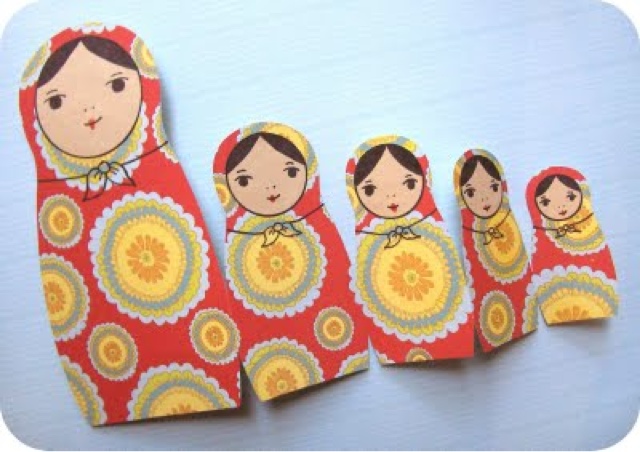
Matryoshka Doll Story

One of my favorite books to read aloud this time of year is Matreshka by Ayers. I have a set of dolls that were given to me by my uncle, after he travelled through the Ukraine. As I read the story, I sing-song the parts for the little doll (kids LOVE the repeating phrases). At the proper intervals, I spin the doll 3 times, and the next smallest "sister" appears, just in time to solve a problem for the heroine of the tale.


Here's a summary from School Library Journal :
Kindergarten-Grade 3-- Drawing upon traditional Russian folklore, Ayres creates an accessible and exciting picture book in which a young girl outwits the evil Baba Yaga. After sharing her meal with an old woman she meets on the road, Kata is given a little wooden doll named Matreshka. Lost in a snowstorm, the child stumbles upon the witch's fearsome house and is given a room for the evening. When Kata realizes she's to be Baba Yaga's next meal, the wooden doll saves her life. Out of the larger Matreshka pop four smaller dolls who find a way out of locked doors, crawl through a mouse's hole, and confuse the witch so thoroughly that she accidently turns herself into a green frog. Natchev's bold, lively illustrations occupy double-page spreads and have a fresh, often whimsical look. The watercolor washes boast a variety of textures, and the characters are depicted in an exaggerated manner. Unfortunately, there is a lack of agreement between text and illustration at the beginning of the book. The text has Kata returning from a trip to town while the illustrations show her just leaving her grandfather's house. Even so, the story will have wide appeal and is suitable for sharing aloud or reading independently. It also makes an entertaining introduction to Russian folklore and culture, especially if told using a set of Russian nesting dolls. --Denise Anton Wright, Illinois State University, Normal


I found a darling craft project that the kids could do with pretty paper... http://zakkalife.blogspot.com/2009/11/craft-project-russian-nesting-doll-card.html